
CO/H₂ trim control
Adaptive combustion control that optimises the fuel-air ratio on its own by approaching the emission edge
LAMTEC
- Software module
- LT3-F + KS1D
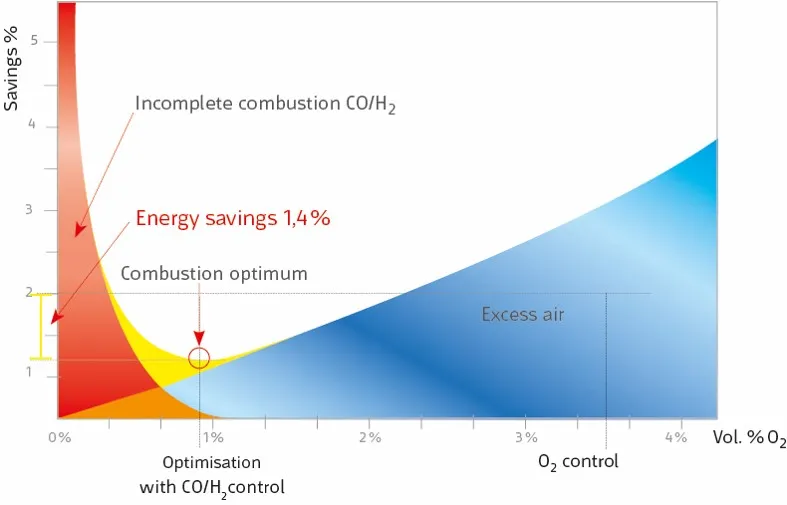
CO/H₂ trim control is a software module in the LAMTEC CMS, BT300, ETAMATIC, ETAMATIC OEM, FMS and VMS combustion management systems. Working with the LT3-F lambda transmitter and the KS1D combination probe, it optimises the fuel-air ratio automatically by moving again and again towards the emission edge, where complete combustion turns into incomplete combustion. At this point emissions and fuel consumption are at their lowest and combustion efficiency at its highest. For natural gas and light fuel oil EL applications, the system is SIL2 fail-safe.
O₂ control relies on measuring the oxygen left in the flue gas, but oxygen alone does not reveal whether combustion is complete, and influences such as false air can distort that reading. When combustion is incomplete, carbon monoxide and hydrogen always appear together. The KS1D probe, made of zirconium dioxide ceramic, measures O₂ and COe — the sum of unburnt components such as CO, H₂ and CxHy — directly and simultaneously in the flue gas. As soon as the probe detects unburnt CO/H₂, the working point is shifted towards a higher lambda, meaning more air and less fuel.
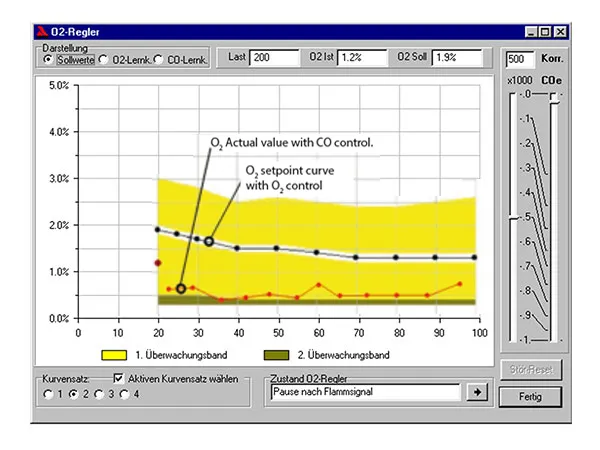
Because the cycle of searching, adjusting, holding and monitoring repeats continuously, the optimum working point is maintained even under unfavourable weather and plant conditions. According to LAMTEC's system overview, the O₂ content of the flue gas can be lowered markedly further than with O₂ trim control, which corresponds to roughly 0.5–2 % higher combustion efficiency and a matching drop in fuel consumption. The O₂ value measured at the same time is not used for the control itself but for monitoring and visualisation, and it acts as a safety function: if O₂ falls below a defined threshold, CO control can be switched off.
CO/H₂ trim control
- Self-optimisation at every load point by continuously approaching the emission edge
- According to LAMTEC, roughly 0.5–2 % higher combustion efficiency than with O₂ trim control
- Better control behaviour thanks to much shorter settling times and feedforward via adaptive correction and learning curves
- Compensation for disturbances such as fluctuations in air pressure or calorific value
- SIL2 to DIN EN 61508 and DIN EN 16340 approval for natural gas and light fuel oil EL applications
- High operational reliability; robust, low-maintenance design proven in service
CO/H₂ trim control
Control principle
- Searching for, setting, holding, further optimising where needed and monitoring the optimum working point close to the emission edge, in a continuously repeated cycle
- Immediate shift of the working point towards more air and less fuel when the KS1D detects unburnt CO/H₂
- Simultaneous O₂ measurement for monitoring and visualisation; CO control can be switched off if O₂ drops below a defined threshold
- Smooth changeover to O₂ trim control at a defined load point if CO control cannot cover the whole load range, for example because of low flame speed
Measurement and system connection
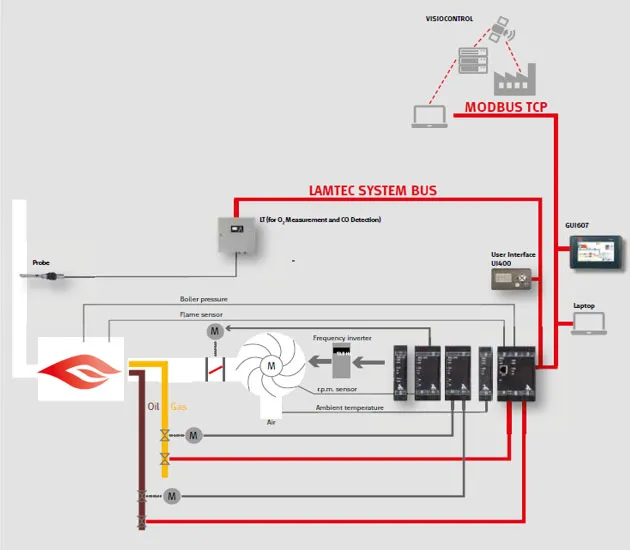
- KS1D combination probe: direct measurement of O₂ and COe in the flue gas with a single sensor
- LT3-F lambda transmitter: fail-safe electronics with two microprocessors; only one probe per LT3-F
- All values needed for control passed from the transmitter to the burner control system over the LAMTEC System Bus (LSB)
- KS1D probe types: flue gas temperature up to 300 °C for the standard and GED/PIF housing versions, up to 1200 °C for the high-temperature (HT) version
- Modular CO/λ control based on LT3 and KS1D for biomass combustion plants
Key specifications
| Specification | CO/H₂ Trim-Control |
|---|---|
| Measuring system | LT3-F + KS1D |
| Integrated in | CMS · BT300 · ETAMATIC · ETAMATIC OEM · FMS · VMS |
| Interfaces | LSB |
| Safety integrity level | SIL2 (for natural gas and light fuel oil EL) |
Approvals and standards
- SIL2 — DIN EN 61508 (natural gas and light fuel oil EL applications)
- DIN EN 16340 (natural gas and light fuel oil EL applications)
Documents
More products in this group
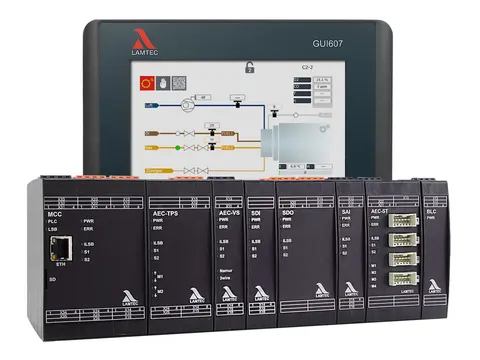
CMS combustion management system
Modular burner and plant control that scales from small industrial burners to large installations
- SIL3 · CE · UL
- ≤ 10 actuators
- Modbus TCP
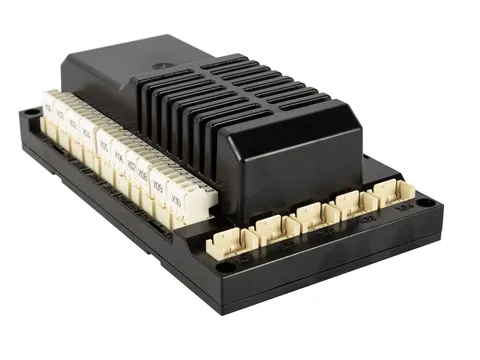
BT300 burner control unit
Compact burner-mounted unit that pairs fuel-air ratio control with a burner sequencer
- ≤ 3 actuators
- Burner-mounted
- SIL3 (BT331, BT341)
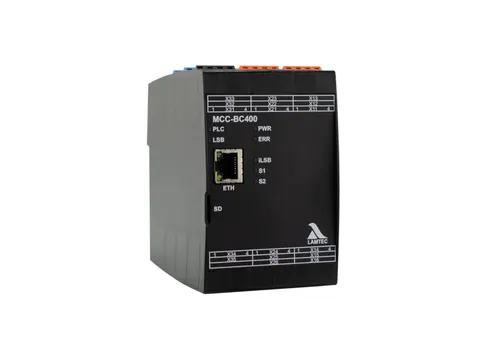
MCC-BC400 burner sequencer
Configurable burner sequencer for gas-fired, oil-fired and dual-fuel burners
- SIL3 · CE · UL
- Gas · Oil · Dual fuel
- Modbus TCP
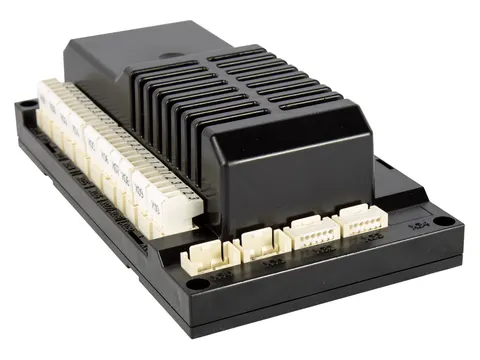
BC300 gas burner sequencer
Burner sequencer for industrial gas burners in thermal process plants, approved for intermittent and continuous operation
- SIL3 · CE
- Intermittent · Continuous
- High-temperature operation > 750 °C
Let's choose the right product for your project together
Tell us about your plant and what you need, and our engineers will recommend the right solution.